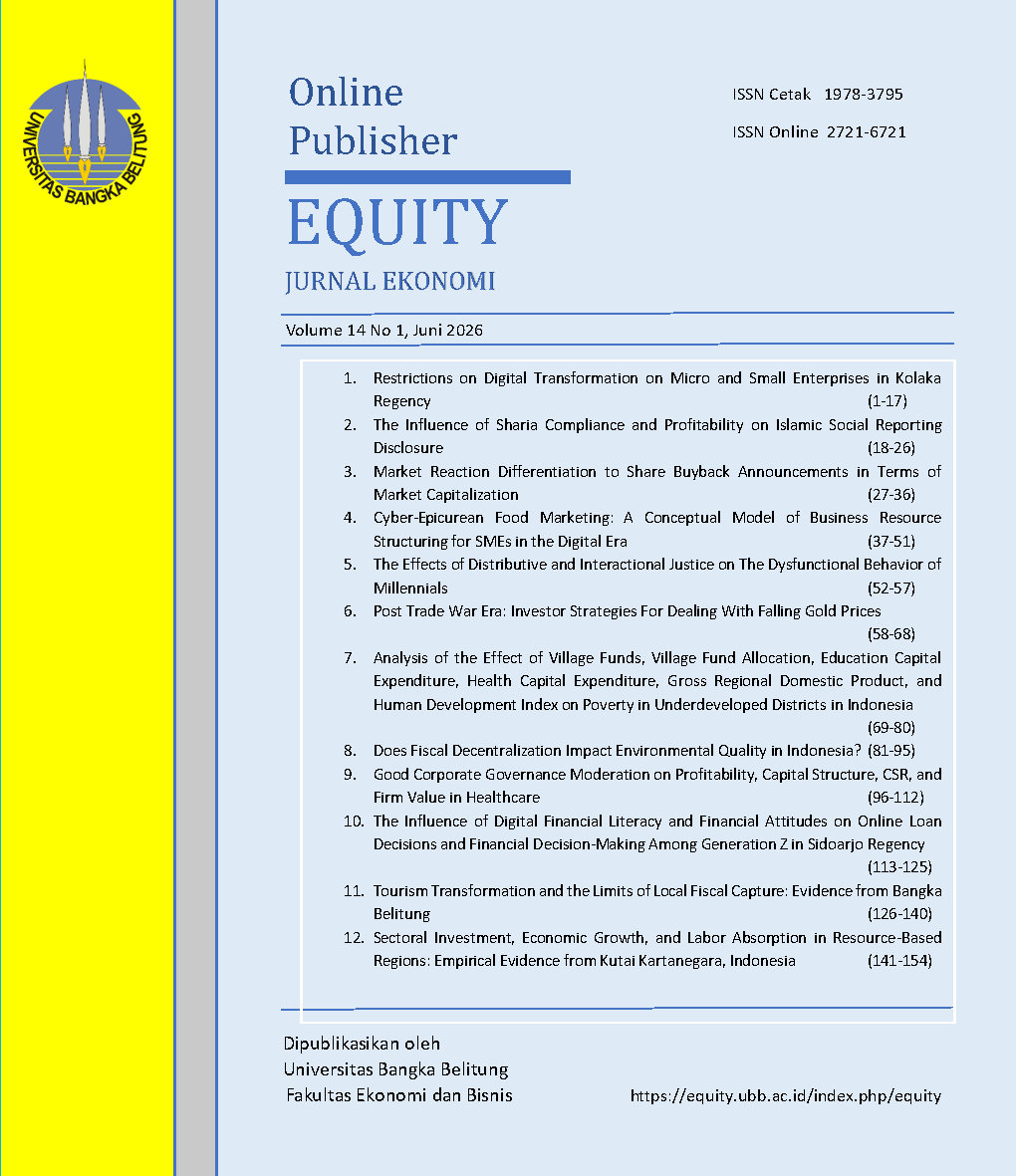
Tourism Transformation and the Limits of Local Fiscal Capture: Evidence from Bangka Belitung
DOI:
https://doi.org/10.33019/equity.v14i1.749Keywords:
Tourism Transformation, Local Revenue , EmploymentAbstract
This study investigates whether tourism-led economic transformation has generated employment and strengthened local fiscal capacity in Bangka Belitung Province, Indonesia. This issue is important because the province has historically relied on tin mining, while tourism has increasingly been positioned as an alternative pathway for post-mining development. Using panel data from seven regencies and municipalities during 2011–2025, the study applies descriptive analysis, fixed-effects estimation, first-difference models, and a dynamic difference-in-differences/event-study approach. Tourism transformation is proxied by the share of tourism-related gross regional domestic product, while local own-source revenue and employment are used as the main outcome variables. The findings show that tourism transformation has not consistently increased local own-source revenue or employment. Event-study estimates indicate a positive early employment response, but no corresponding improvement in fiscal capacity. These results suggest that tourism creates labor-market benefits more rapidly than local fiscal gains, revealing a weak mechanism of local revenue capture from tourism activity. The study underscores the importance of strengthening tourism fiscal governance, business formalization, digital tax administration, and linkages between tourism and local micro, small, and medium enterprises.
Downloads
References
Armis, R., & Kanegae, H. (2021). Regional competitiveness of a post‐mining city in tourism: Ombilin coal mining heritage of Sawahlunto, Indonesia. Regional Science Policy & Practice, 13(6), 1888–1911. https://doi.org/10.1111/rsp3.12404
Awoa Awoa, P., & Ondoa, H. A. (2024). Heterogeneous role of resource dependence on industrialization in developing countries. Comparative Economic Studies, 66(4), 753–781. https://doi.org/10.1057/s41294-023-00231-9
Badeeb, R. A., Lean, H. H., & Clark, J. (2017). The evolution of the natural resource curse thesis: A critical literature survey. Resources Policy, 51, 123–134. https://doi.org/10.1016/j.resourpol.2016.10.015
Baltagi, B. H. (2021). Econometric Analysis of Panel Data. Springer.
Baum, T., Kralj, A., Robinson, R. N. S., & Solnet, D. J. (2016). Tourism workforce research: A review, taxonomy and agenda. Annals of Tourism Research, 60, 1–22. https://doi.org/10.1016/j.annals.2016.04.003
Bellofatto, A. A., & Besfamille, M. (2018). Regional state capacity and the optimal degree of fiscal decentralization. Journal of Public Economics, 159, 225–243. https://doi.org/10.1016/j.jpubeco.2017.12.010
Callaway, B., & Sant’Anna, P. H. C. (2021). Difference-in-Differences with multiple time periods. Journal of Econometrics, 225(2), 200–230. https://doi.org/10.1016/j.jeconom.2020.12.001
Cameron, A. C., & Miller, D. L. (2015). A Practitioner’s Guide to Cluster-Robust Inference. Journal of Human Resources, 50(2), 317 LP – 372. https://doi.org/10.3368/jhr.50.2.317
Diao, X., McMillan, M., & Rodrik, D. (2017). The Recent Growth Boom in Developing Economies: A Structural Change Perspective (23132). https://doi.org/10.3386/w23132
Dwyer, L. (2024). Measuring the Sustainability of Tourism (SF-MST): New Wine in an Old Bottle? In Sustainability (Vol. 16, Issue 14, p. 5867). https://doi.org/10.3390/su16145867
Elgin, C., & Elveren, A. Y. (2024). Unpacking the economic impact of tourism: A multidimensional approach to sustainable development. Journal of Cleaner Production, 478, 143947. https://doi.org/10.1016/j.jclepro.2024.143947
Erumban, A. A., & de Vries, G. J. (2024). Structural change and poverty reduction in developing economies. World Development, 181, 106674. https://doi.org/10.1016/j.worlddev.2024.106674
Ibrahim, I., Sulista, S., & Pratama, S. (2022). Struggling for power over the Bangka coast: Tin amongst the vortex of companies, the state, and residents. The Extractive Industries and Society, 10, 101055. https://doi.org/10.1016/j.exis.2022.101055
Jia, J., Ding, S., & Liu, Y. (2020). Decentralization, incentives, and local tax enforcement. Journal of Urban Economics, 115, 103225. https://doi.org/10.1016/j.jue.2019.103225
Ladkin, A., Mooney, S., Solnet, D., Baum, T., Robinson, R., & Yan, H. (2023). A review of research into tourism work and employment: Launching the Annals of Tourism Research curated collection on tourism work and employment. Annals of Tourism Research, 100, 103554. https://doi.org/10.1016/j.annals.2023.103554
Lashitew, A. A., Ross, M. L., & Werker, E. (2021). What Drives Successful Economic Diversification in Resource-Rich Countries? The World Bank Research Observer, 36(2), 164–196. https://doi.org/10.1093/wbro/lkaa001
Lusiana, Neldi, M., Sanjaya, S., & Zefriyenni. (2021). The Effect of Number of Visitors, Tourist Destinations, Hotel Room Tax and Accommodations on Original Local Government Revenue: Case Study West Sumatra Province, Indonesia. International Journal of Financial Research, 12(3), 230–239. https://doi.org/10.5430/ijfr.v12n3p230
Lv, Z. (2020). Does tourism affect the informal sector? Annals of Tourism Research, 80, 102816. https://doi.org/10.1016/j.annals.2019.102816
Martinez-Vazquez, J., Lago-Peñas, S., & Sacchi, A. (2017). The Impact of Fiscal Decentralization: A Survey. Journal of Economic Surveys, 31(4), 1095–1129. https://doi.org/https://doi.org/10.1111/joes.12182
McCullough, C. D., Schultze, M., & Vandenberg, J. (2020). Realizing Beneficial End Uses from Abandoned Pit Lakes. In Minerals (Vol. 10, Issue 2, p. 133). https://doi.org/10.3390/min10020133
Measham, T., Walker, J., Haslam McKenzie, F., Kirby, J., Williams, C., D’Urso, J., Littleboy, A., Samper, A., Rey, R., Maybee, B., Brereton, D., & Boggs, G. (2024). Beyond closure: A literature review and research agenda for post-mining transitions. Resources Policy, 90, 104859. https://doi.org/10.1016/j.resourpol.2024.104859
Nguyen, P. C., Schinckus, C., Chong, F. H. L., Nguyen, B. Q., & Tran, D. L. T. (2025). Tourism and contribution to employment: global evidence. Journal of Economics and Development, 27(1), 22–37. https://doi.org/10.1108/JED-07-2024-0269
Nicola, S., & Schmitz, S. (2024). From Mining to Tourism: Assessing the Destination’s Image, as Revealed by Travel-Oriented Social Networks. In Tourism and Hospitality (Vol. 5, Issue 2, pp. 395–415). https://doi.org/10.3390/tourhosp5020025
Pagouni, C., Pavloudakis, F., Kapageridis, I., & Yiannakou, A. (2024). Transitional and Post-Mining Land Uses: A Global Review of Regulatory Frameworks, Decision-Making Criteria, and Methods. In Land (Vol. 13, Issue 7, p. 1051). https://doi.org/10.3390/land13071051
Pratiwi, Narendra, B. H., Siregar, C. A., Iskandar, Mulyanto, B., Suwardi, Suryaningtyas, D. T., Dharmawan, I. W., Suharti, S., & Marsandi, F. (2025). Tin Mining and Post-Tin Mining Reclamation Initiatives in Indonesia: With Special Reference to Bangka Belitung Areas. Land, 14(10), 1947. https://doi.org/10.3390/land14101947
Pukowiec-Kurda, K., & Apollo, M. (2024). From coal to tourism: a game-changer in the sustainable transition process. Journal of Tourism Futures, 10(3), 454–460. https://doi.org/10.1108/JTF-05-2024-0086
Rodrik, D. (2016). Premature deindustrialization. Journal of Economic Growth, 21(1), 1–33. https://doi.org/10.1007/s10887-015-9122-3
Rosa, J. C. S., Sánchez, L. E., & Morrison-Saunders, A. (2018). Getting to ‘agreed’ post-mining land use – an ecosystem services approach. Impact Assessment and Project Appraisal, 36(3), 220–229. https://doi.org/10.1080/14615517.2018.1445175
Rosselló-Nadal, J., & Sard, M. (2026). Tourism Taxation: Balancing revenues, competitiveness and sustainability in destination management. Tourism Management, 113, 105326. https://doi.org/10.1016/j.tourman.2025.105326
Saptono, P. B., Khozen, I., & Hodžić, S. (2023). Local Government Taxing Power for Digital Consumption: A Case Study of Hotel, Restaurant, and Entertainment Taxes in Indonesia. Lex Localis - Journal of Local Self-Government, 21(4), 1141–1165. https://doi.org/10.4335/21.4.1141-1165(2023)
Sulista, S., & Rosyid, F. A. (2022). The economic impact of tin mining in Indonesia during an era of decentralisation, 2001–2015: A case study of Kepulauan Bangka Belitung Province. The Extractive Industries and Society, 10, 101069. https://doi.org/10.1016/j.exis.2022.101069
Sun, Z., Liu, L., Pan, R., Wang, Y., & Zhang, B. (2025). Tourism and economic growth: The role of institutional quality. International Review of Economics & Finance, 98, 103913. https://doi.org/10.1016/j.iref.2025.103913
Tyagi, S. (2024). Impact of tourism sustainability on regional development: a systematic literature review. Journal of Policy Research in Tourism, Leisure and Events, 16(3), 290–309. https://doi.org/10.1080/19407963.2024.2316733
Wooldridge, J. M. (2010). Econometric Analysis of Cross Section and Panel Data (2nd ed.). MIT Press.
Zhang, J. (2021). The effects of tourism on income inequality: A meta-analysis of econometrics studies. Journal of Hospitality and Tourism Management, 48, 312–321. https://doi.org/10.1016/j.jhtm.2021.07.009
Zhang, Y., Papp-Váry, Á., & Szabó, Z. (2025). Global influences of digital transformation on behavioral factors in tourism: a systematic literature review. Cogent Business & Management, 12(1), 2536101. https://doi.org/10.1080/23311975.2025.2536101
Downloads
Published
Issue
Section
License
Copyright (c) 2026 Muhamad Mufti Arkan, Devi Valeriani, Annisa Deni Istina, Andi Kurniawan Karta Negara

This work is licensed under a Creative Commons Attribution 4.0 International License.
Authors who publish journals in Equity: Jurnal Ekonomi agrees with the following conditions:
1. Authors retain copyright and grant the journal right of first publication with the work simultaneously licensed under a Creative Commons Attribution 4.0 International License.
2. Authors are able to enter into separate, additional contractual arrangements for the non-exclusive distribution of the journal's published version of the work (e.g., post it to an institutional repository or publish it in a book), with an acknowledgement of its initial publication in this journal.
3. Every publication (printed/electronic) are open access for educational purposes, research, and library. Other than the aims mentioned above, the editorial board is not responsible for copyright violation.
How to Cite