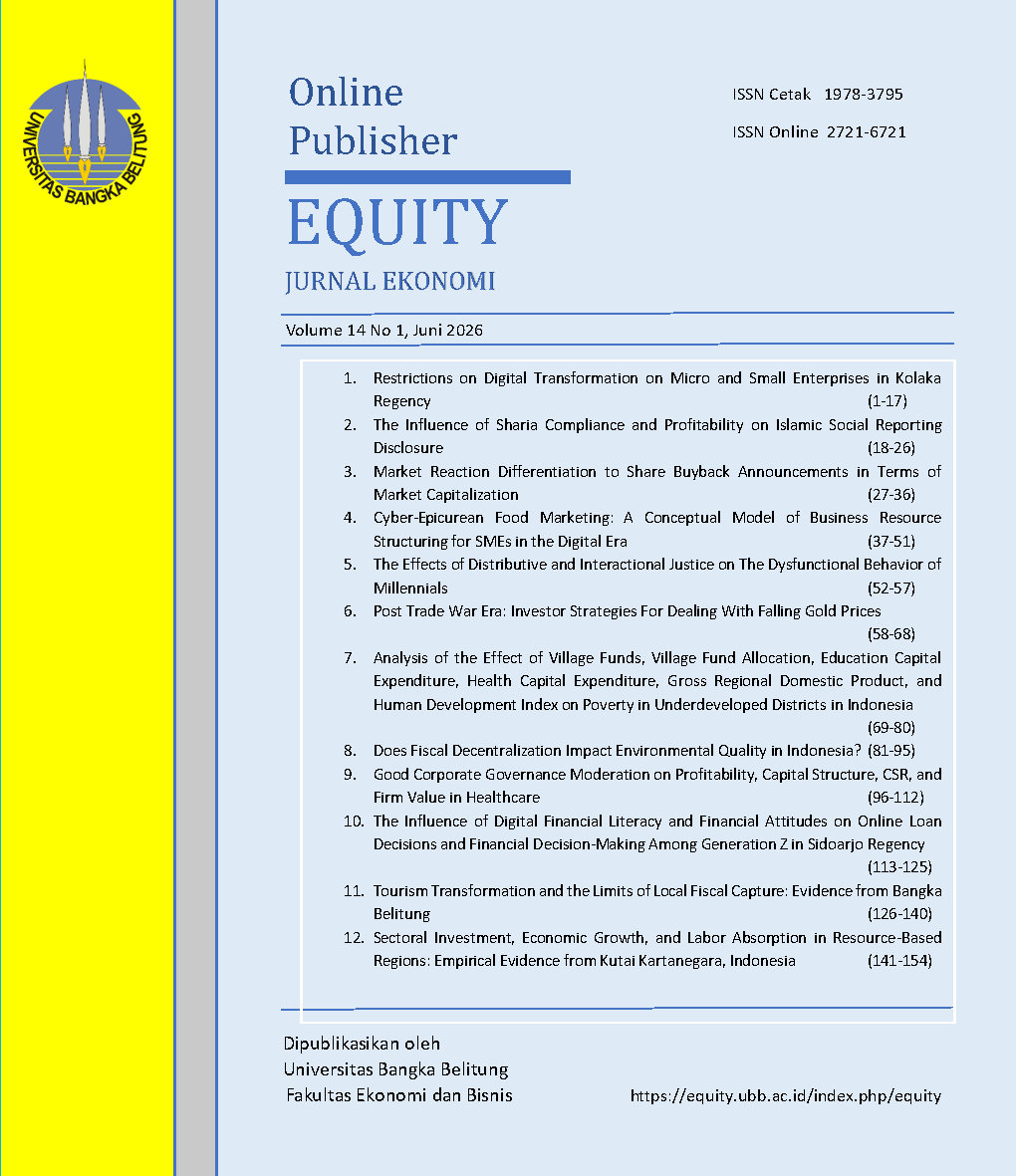
Sectoral Investment, Economic Growth, and Labor Absorption in Resource-Based Regions: Empirical Evidence from Kutai Kartanegara, Indonesia
DOI:
https://doi.org/10.33019/equity.v14i1.738Keywords:
Sectoral investment, economic growth, Labor Absorption, jobless growth, path analysisAbstract
This study aims to analyze the effect of sectoral investment on economic growth and labor absorption in Kutai Kartanegara Regency using a mediation framework. The study employs an explanatory quantitative approach using time-series data for 2016–2025 and applies path analysis to examine direct and indirect relationships among the variables. Gross Regional Domestic Product (GRDP) data were obtained from Badan Pusat Statistik (Statistics Indonesia) based on the February 27, 2026 release of the 2010 Series publication, Gross Regional Domestic Product at Constant Prices by Industrial Origin (Billion Rupiah), in which the 2023 data are preliminary and the 2024–2025 data are very preliminary. The results show that primary sector investment has a positive and significant effect on economic growth (β = 0.714; p = 0.013). Primary sector investment (β = 0.455; p = 0.033) and tertiary sector investment (β = 0.507; p = 0.040) also have positive and significant effects on labor absorption, whereas secondary sector investment has no significant effect. Economic growth does not significantly affect labor absorption (β = -0.610; p = 0.212) and does not mediate the relationship between sectoral investment and labor absorption based on the Sobel test (p = 0.185). These findings indicate jobless growth, where rising regional output is not fully accompanied by proportional employment opportunities. Therefore, regional investment policies should prioritize more labor-intensive sectors to promote inclusive and sustainable economic growth. This study contributes to the literature on jobless growth in resource-based regions
Downloads
References
Aghion, P., & Howitt, P. (1992). A model of growth through creative destruction. Econometrica, 60(2), 323–351. https://doi.org/10.2307/2951599
Ahmed, Z., & Bibi, S. (2023). Economic growth, employment elasticity, and structural transformation in developing economies. Sustainability, 15(8), 6412. https://doi.org/10.3390/su15086412
Andriansyah, A., Nurwanda, A., & Rifai, B. (2023). Structural change and regional economic growth in Indonesia. Bulletin of Indonesian Economic Studies, 59(1), 91–117. https://doi.org/10.1080/00074918.2021.1914320
Barro, R. J. (1991). Economic growth in a cross section of countries. Quarterly Journal of Economics, 106(2), 407–443. https://doi.org/10.2307/2937943
Butkus, M. (2024). When and for whom does growth become jobless? Economies, 12(1), 19. https://doi.org/10.3390/economies12010019
Gunawan, B. T. (2023). Do natural resources affect unemployment? Evidence from Indonesian province panel data. Signifikan: Jurnal Ilmu Ekonomi, 12(2), 231–244. https://doi.org/10.15408/sjie.v12i2.31824
Hutabarat, T., & Simanjuntak, R. (2022). Investment and labor absorption in regional economic development. Jurnal Ekonomi Pembangunan, 20(1), 45–60. (No DOI available)
International Labour Organization. (2021). World employment and social outlook: Trends 2021. Geneva: ILO. https://www.ilo.org/publications/world-employment-and-social-outlook-trends-2021
Keynes, J. M. (1936). The general theory of employment, interest and money. London: Macmillan.
Kapsos, S. (2005). The employment intensity of growth: Trends and macroeconomic determinants. Employment Strategy Papers No. 12. Geneva: International Labour Organization.
Lewis, W. A. (1954). Economic development with unlimited supplies of labour. The Manchester School, 22(2), 139–191. https://doi.org/10.1111/j.1467-9957.1954.tb00021.x
Liu, L., Li, Y., & Wang, Z. (2023). Employment effect of structural change in strategic emerging industries. Processes, 11(2), 599. https://doi.org/10.3390/pr11020599
Lucas, R. E. (1988). On the mechanics of economic development. Journal of Monetary Economics, 22(1), 3–42.
Murshed, M., Alam, M. S., & Mahmood, H. (2022). Resource dependence, economic growth, and employment nexus in developing countries. Resources Policy, 78, 102857. https://doi.org/10.1016/j.resourpol.2022.102857
Okun, A. M. (1962). Potential GNP: Its measurement and significance. Proceedings of the Business and Economic Statistics Section of the American Statistical Association, 98–104.
Romer, P. M. (1990). Endogenous technological change. Journal of Political Economy, 98(5), S71–S102. https://doi.org/10.1086/261725
Sari, M., & Prasetyo, B. (2021). Labor quality and economic growth. Jurnal Ekonomi Indonesia, 17(2), 89–102. (No DOI available)
Solow, R. M. (1956). A contribution to the theory of economic growth. Quarterly Journal of Economics, 70(1), 65–94.
Syahrir, R., Wall, F., & Diallo, P. (2020). Socio-economic impacts and sustainability of mining: A case study of the historical tin mining in Singkep Island-Indonesia. The Extractive Industries and Society, 7(4), 1525–1533. https://doi.org/10.1016/j.exis.2020.07.023
Todaro, M. P., & Smith, S. C. (2012). Economic development (11th ed.). Boston: Pearson.
World Bank. (2020). Jobs and Economic Transformation. Washington, DC: World Bank Group. Available at: https://ida.worldbank.org/en/topics/theme/jobs-and-economic-transformation
Zheng, X., Zhang, Y., & Li, J. (2023). Digital transformation, industrial structure change, and economic growth. PLOS ONE, 18(5), e0284803. https://doi.org/10.1371/journal.pone.0284803
Downloads
Published
Issue
Section
License
Copyright (c) 2026 Yurita Eriani, Dr. Juliansyah Roy, SE., M.Si, Dr. Diana Lestari, SE., M.Si

This work is licensed under a Creative Commons Attribution 4.0 International License.
Authors who publish journals in Equity: Jurnal Ekonomi agrees with the following conditions:
1. Authors retain copyright and grant the journal right of first publication with the work simultaneously licensed under a Creative Commons Attribution 4.0 International License.
2. Authors are able to enter into separate, additional contractual arrangements for the non-exclusive distribution of the journal's published version of the work (e.g., post it to an institutional repository or publish it in a book), with an acknowledgement of its initial publication in this journal.
3. Every publication (printed/electronic) are open access for educational purposes, research, and library. Other than the aims mentioned above, the editorial board is not responsible for copyright violation.
How to Cite