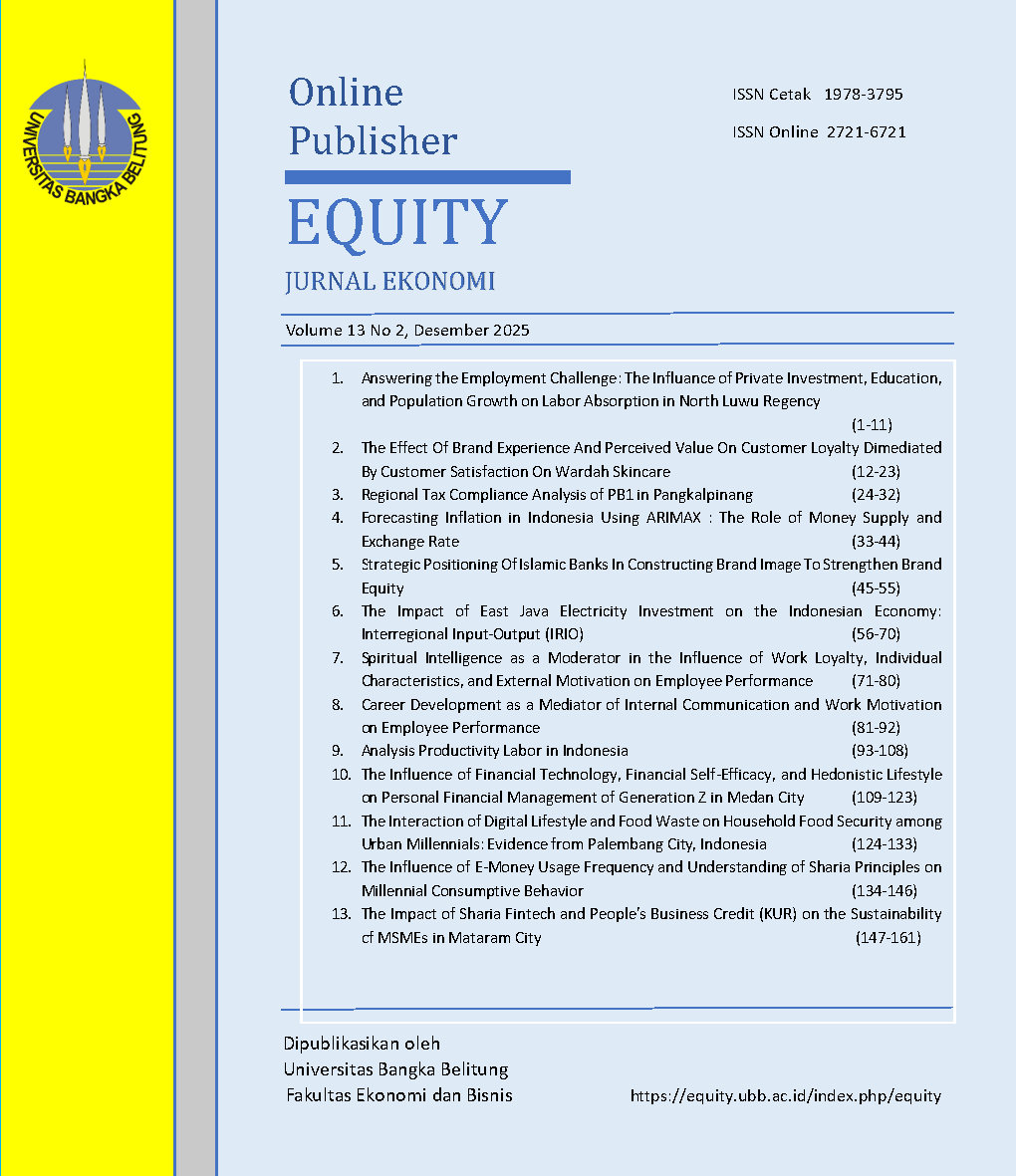
The Impact of Sharia Fintech and People's Business Credit (KUR) on the Sustainability of MSMEs in Mataram City
DOI:
https://doi.org/10.33019/equity.v13i2.598Keywords:
Business Sustainability, MSMEs, People's Business Credit (KUR); , Sharia Financing, Sharia FintechAbstract
This study aims to analyse the impact of Sharia Fintech and People's Business Credit (KUR) on the sustainability of MSMEs in Mataram City. This study is important because MSMEs still have limited access to financing, so the use of technology-based financial services and subsidised credit programmes is necessary to support business continuity. The study uses a quantitative approach with a survey method of 100 MSME actors selected through purposive sampling. The research instrument is a questionnaire with a 1–5 Likert scale, which is then analysed using multiple linear regression through SPSS version 22. The results show that Sharia Fintech has a positive and significant effect on the sustainability of MSMEs, as reflected in increased access to financing, operational efficiency, and innovation capabilities. In addition, KUR also has a positive and significant effect on the sustainability of MSMEs through capital strengthening, increased production capacity, and improved business stability. Simultaneously, both variables were proven to contribute significantly to the sustainability of MSMEs in Mataram City. Thus, it can be concluded that the integration of Sharia-based technology financing and government credit programmes can improve the sustainability performance of MSMEs and has the potential to become a strategic instrument in local economic development.
Downloads
References
Alfira, A., Nurdin, F., Hikmah, A. N., Yudiyanti, E., Gustiana, G., Fatimah, S., & Asmiranda, A. (2024). Peranan Kredit Usaha Rakyat (KUR) Terhadap Pengembangan UMKM Di Kabupaten Sinjai. Jurnal Riset Multidisiplin, 1(3), 116–125. https://doi.org/10.61316/jrma.v1i3.21
Amelia Nur’aeni. (2024). Inovasi Fintech Syariah dalam Pembiayaan Mikro: Solusi Digital untuk Pemberdayaan Ekonomi. Jurnal Nuansa : Publikasi Ilmu Manajemen Dan Ekonomi Syariah, 2(4), 153–161. https://doi.org/10.61132/nuansa.v2i4.1371
Andri Ibrahim, M., Eprianti, N., & Rizki Febriadi, S. (2023). Crowdfunding Sharia Financing Model as Alternative Business Capital Financing for MSMES. KnE Social Sciences, 1461–1474. https://doi.org/10.18502/kss.v8i18.14358
Anggara, M. R. (2025). Enhancing The Sustainability Of Small And Medium Enterprises ( SMEs ) Through Islamic FinTech : A Comprehensive Review Of Emerging Trends ( 2018-2024 ). Civilization Research: Journal of Islamic Studies, 4(1), 21–37. https://doi.org/https://doi.org/10.61630/crjis.v4i1.50
Apia Dewi Agustin, & Muhammad Hanif Ibrahim. (2024). From Exclusion To Inclusion: The Role Of Financial Technology In Enhancing Sustainability Performance In Indonesian Muslim MSMEs. Journal of Finance, Economics and Business, 3(2), 122–142. https://doi.org/10.59827/jfeb.v3i2.147
Aristanto, E. (2019). Kredit Usaha Rakyat (KUR) : Pilihan Kebijakan Afirmatif Mendorong Pengembangan Usaha Mikro, Kecil, dan Menengah di Indonesia. Journal of Banking and Finance, 1(1), 10–23.
Azizah, S. N. (2024). Kontribusi Fintech Syariah dalam Mendukung Pertumbuhan UMKM di Indonesia : Kajian Empiris Aspek Peran Dan Hambatan.
Berliansyah, R. A., & Khoirunnurofik, K. (2023). Micro Small Industries Performance Improvement: Analysis of the KUR Program. Economics Development Analysis Journal, 12(3), 381–395. https://doi.org/10.15294/edaj.v12i3.65457
Chandra, K., Margaretha, F., Nilasari, M., Santosa, B., Rahmawati, U. N., Lebbytha, V., Salshabilla, D., & Mikro, U. (2024). Pemberdayaan Pengusaha UMKM melalui Pinjaman Berbunga Rendah Bersubsidi Pemerintah di Platform Digital. Jurnal Pengabdian Masyarakat Akademisi, 3(3), 150–153. https://doi.org/https://doi.org/10.54099/jpma.v3i3.1068
Khafifah, A., & Dianta, K. (2022). Peranan Kredit Usaha Rakyat (Kur) Pada Perkembangan Usaha Mikro, Kecil Dan Menengah (UMKM) (Studi Kasus pada UMKM Minuman Kekinian di Daerah Jakarta Selatan). Jurnal Ekonomi Kreatif Dan Manajemen Bisnis Digital, 1(1), 79–93. https://transpublika.co.id/ojs/index.php/JEKOMBITAL
Mu’afifah, L., & Sukardi, B. (2023). Literacy, Trust, and Risk Affect Sharia Fintech Financing Intentions on Umkm Actors in Central Java. Jurnal Perbankan Syariah, 2(2), 21–37. https://doi.org/10.20414/jps.v2i2.8567
Mugiati, M. (2024). The Effect Of People’s Bussines Credit (KUR) PT. Papua Regional Development Bank Sentani BranchToward Micro Small And Medium Enterprises (MSMEs) In Jayapura District. International Journal of Accounting & Finance in Asia Pasific, 7(1), 33–45. https://doi.org/10.32535/ijafap.v7i1.2880
Nst, Y. A. (2024). Peran UMKM Dalam Meningkatkan Pertumbuhan Ekonomi Lokal. Jurnal Bangun Manajemen, 3(2), 219–224. https://doi.org/10.56854/jbm.v3i2.487
Puspita, S. E., & Mahdani, S. (2024). Pengaruh Distribusi Penyaluran Kredit Usaha Rakyat (KUR) Terhadap Kinerja Usaha Micro Kecil Dan Menengah di Kabupaten Aceh Barat Daya. Innovative: Journal Of Social Science Research, 4(1), 4930–4943. https://j-innovative.org/index.php/Innovative/article/view/7804
Putri, C. (2024). Pengaruh Modal Sendiri Dan Kredit Usaha Rakyat (KUR) Terhadap Pendapatan Usaha (Studi Pada UMKM di Desa Padang Birik-Birik Kecamatan Pariaman Utara Kota Pariaman). Jurnal Akuntansi Keuangan Dan Bisnis, 1(4), 953–965. https://jurnal.ittc.web.id/index.php/jakbs/article/view/800
Safarina Dewi, I., & Hermawan Adinugraha, H. (2023). The Role Of Sharia Fintech In Improving Halal Financial Inclusion In Msmes In Indonesia. LIKUID: Jurnal Ekonomi Industri Halal, 3(1). https://doi.org/10.15575/likuid.v3i1.18693
Salam, A., & Imilda. (2024). Transformasi Digital UMKM Indonesia di Era Industri 5.0: Studi Kasus di Kota Banda Aceh. Jurnal Manajemen Dan Teknologi, 1(1), 1–10. https://doi.org/10.63447/jmt.v1i1.772
Shannia Angelia Rahardjo, Tarsisius Murwadji, & Helza Nova Lita. (2025). Efektivitas Hukum Jaminan Performa Kredit UMKM Melalui Penerapan Innovative Credit Scoring. Jembatan Hukum : Kajian Ilmu Hukum, Sosial Dan Administrasi Negara, 2(2), 73–81. https://doi.org/10.62383/jembatan.v2i2.1607
Shoffan Hasyim, I., Hanif, H., & Anggraeni, E. (2022). Analysis of Perceived Usefulness, Perceived Ease of Use, Trust, And Sharia Financial Literature on The Adoption of Sharia Fintech By MSMEs. Al-Kharaj : Jurnal Ekonomi, Keuangan & Bisnis Syariah, 5(3), 1218–1234. https://doi.org/10.47467/alkharaj.v5i3.1572
Supardi, A., & Wijaya, G. (2023). Meningkatkan Kinerja UMKM Melalui Pendampingan Manajerial. Jurnal Peradaban Masyarakat, 3(3), 2023. https://doi.org/https://doi.org/10.55182/jpm.v3i3.528
Supriadi, E. (2024). Peran Financial Technology ( Fintech ) Syariah dalam Meningkatkan Inklusi Keuangan di Indonesia : Analisis Perspektif Ekonomi Islam. EKSISBANK (Ekonomi Syariah Dan Bisnis Perbankan), 8(2), 255–263. https://doi.org/https://doi.org/10.37726/ee.v8i2.1551
Syamsu Rijal, & Supriandi, S. (2024). The Impact of Working Capital Management, Product Innovation, and Financial Management on MSME Business Sustainability in South Sulawesi. West Science Journal Economic and Entrepreneurship, 2(04), 568–580. https://doi.org/10.58812/wsjee.v2i04.1410
Trizuwani, S., Zen, M., & Fatmawati. (2025). Fintech Syariah Dalam Mendistribusikan Produk Keuangan Islam Dan Meningkatkan Kesejahteraan Ekonomi Umat. Jurnal Ekonomi & Perbankan Syariah, 5(1). https://doi.org/https://doi.org/10.37598/jeips.v5i1.2417
Wulandari, A. S., & Setiyowati, A. (2022). Implementasi Pembiayaan Kredit Usaha Rakyat (KUR) Mikro Syariah Pada Bank Syariah Indonesia KCP Rungkut 1. Musyarakah: Journal of Sharia Economic (MJSE), 2(2), 140–146. https://doi.org/10.24269/mjse.v2i2.6502
Zahra, L. A. M. (2024). Implementasi Kebijakan Kredit Usaha Rakyat Guna Mendorong Peningkatan UMKM di Kantor Cabang Non Metro Bank BRI Jakarta 3 Laras Ayu Maulida Zahra Universitas Pembangunan Nasional “ Veteran ” Jawa Timur . MES Management Journal, 3, 467–475. https://doi.org/https://doi.org/10.56709/mesman.v3i2.337
Zuchroh, I. (2022). Sharia Fintech: Horizon of MSME Financing in Indonesia. EKOMBIS REVIEW: Jurnal Ilmiah Ekonomi Dan Bisnis, 10(1), 443–451. https://doi.org/10.37676/ekombis.v10i1.1622
Zulfa, M. H. (2025). Peran financial technology syariah dalam meningkatkan inklusi keuangan di kalangan UMKM berbasis syariah di Indonesia. JEPP : Jurnal Ekonomi Pembangunan Dan Pariwisata, 5(1), 36–41. https://doi.org/10.52300/jepp.v5i1.20311
Downloads
Published
Issue
Section
License
Copyright (c) 2025 Safina, Nur Fitri Hidayanti, Zaenafi Ariani, Mukhlishin

This work is licensed under a Creative Commons Attribution 4.0 International License.
Authors who publish journals in Equity: Jurnal Ekonomi agrees with the following conditions:
1. Authors retain copyright and grant the journal right of first publication with the work simultaneously licensed under a Creative Commons Attribution 4.0 International License.
2. Authors are able to enter into separate, additional contractual arrangements for the non-exclusive distribution of the journal's published version of the work (e.g., post it to an institutional repository or publish it in a book), with an acknowledgement of its initial publication in this journal.
3. Every publication (printed/electronic) are open access for educational purposes, research, and library. Other than the aims mentioned above, the editorial board is not responsible for copyright violation.
How to Cite