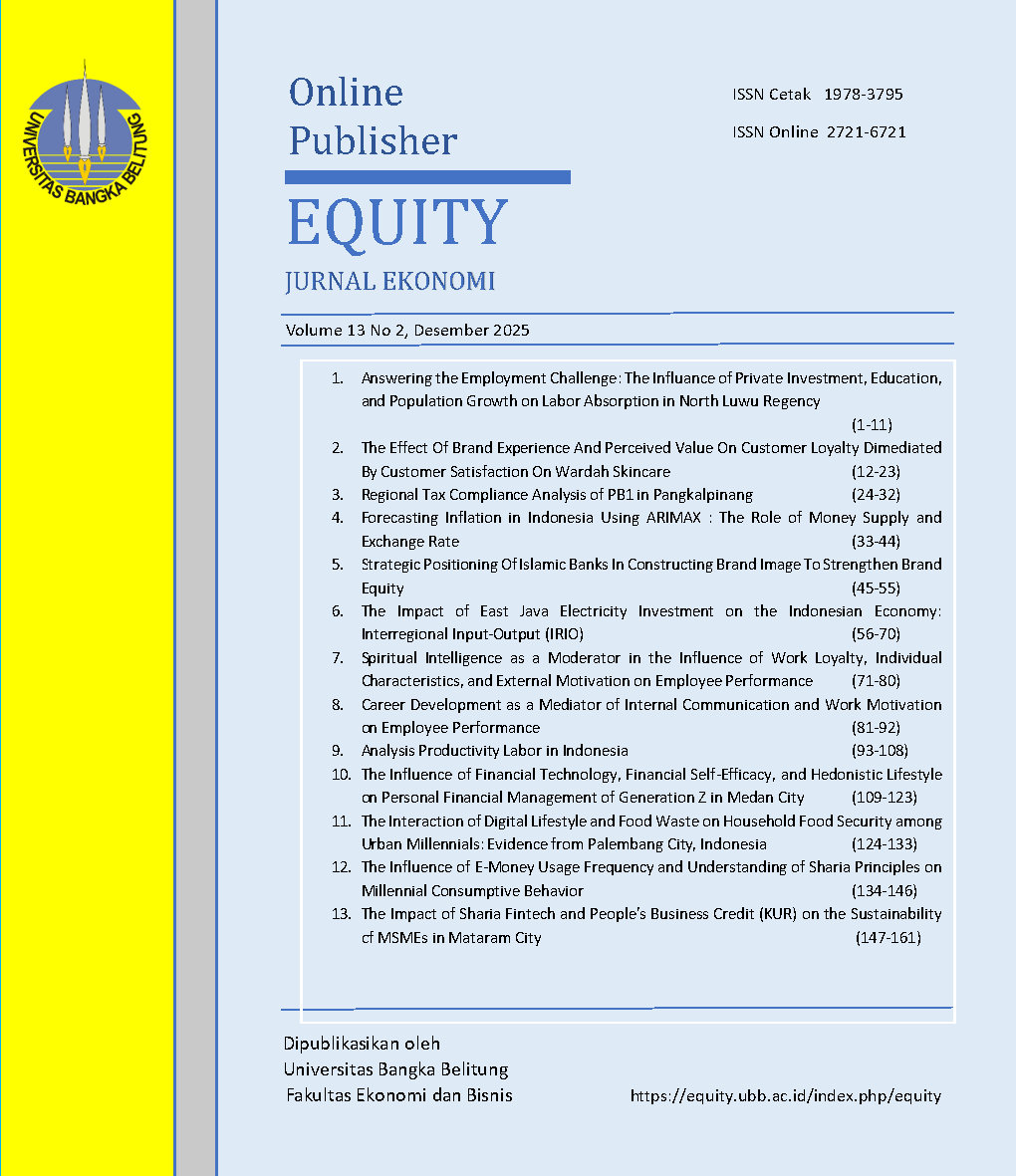
The Influence of E-Money Usage Frequency and Understanding of Sharia Principles on Millennial Consumptive Behavior
DOI:
https://doi.org/10.33019/equity.v13i2.592Abstract
The utilization of electronic money (e-money) has significantly increased in the era of digitalization, altering the consumption patterns of Muslim millennials in Mataram. This study aims to investigate the impact of the frequency of e-money usage and the level of understanding of Sharia principles on Sharia-compliant consumption behavior. Employing a quantitative research design, the study surveyed 93 respondents selected through simple random sampling. Data analysis was conducted using multiple linear regression with the assistance of SPSS software. The findings reveal that the frequency of e-money usage exerts a positive and statistically significant influence on consumption behavior aligned with Sharia principles, exhibiting a coefficient of 54.4% and a significance value of 0.00. Furthermore, the understanding of Sharia values demonstrates a positive effect of 28.3%, with a significance value of 0.013. Collectively, these two variables exert a robust influence on Sharia-oriented consumption behavior, as indicated by an F value of 51.99 and an R-squared value of 52.6%. These results suggest that an increased frequency of e-money usage, coupled with a deeper understanding of Sharia principles, corresponds to more ethical and balanced consumption behavior among Muslim millennials. Consequently, it is imperative to enhance digital literacy in conjunction with strengthening Sharia financial literacy, ensuring that the adoption of financial technology aligns with the objectives of Maqashid al-Syariah in fostering economic welfare and accountability in the digital age.
Downloads
References
Alriani, A., Komariah, K., Sani, A., & Setianti, Y. (2017). The Usage of E-Money A Phenomenological Study of E-Money Usage by Users in Bandung City. KnE Social Sciences, 2(4), 44. https://doi.org/10.18502/kss.v2i4.866
Aryadipura, S., & Margaliu, M. F. (2025). How E-Wallet Usage Triggers Impulsive Buying in Online Live Shopping Platform : Evidence from Indonesia. MATRIK:JMBK, 19(2), 124–142. https://doi.org/https://doi.org/10.24843/MATRIK:JMBK.2025.v19.i02.p02
Astuti, M. D., & Wardani, M. K. (2024). Pengaruh Kemudahan Penggunaan Paylater Terhadap Perilaku Konsumtif dengan Lifestyle sebagai Pemoderasi Pendahuluan. MASTER:Jurnal Manajemen Strategik Kewirausahaan, 4(2), 147–154. https://doi.org/https://doi.org/10.37366/master.v4i2.1481
Bank Indonesia. (2025). Laporan kebijakan moneter. https://www.bi.go.id/id/publikasi/laporan/Pages/Laporan-Kebijakan-Moneter-Triwulan-I-2025.aspx
Dar, K., Bin, A., & Husni, M. (2022). Manifestation of Moderation in the Context of Islamic Law : Maqasid Study Ahmad Bin Muhammad Husni ( Corresponding Author ) Department of Fiqh & Usul al-Fiqh . Kulliyyah of Islamic Revealed Knowledge & Human Sciences , ( KIRKHS ) International Islamic Uni. Al-Hikmah International Journal for Islamic Studies & Human Sciences, 5(2), 26–44. https://doi.org/https://doi.org/10.46722/hikmah.v5i2.248
Fadillah, A. N., & Lubis, D. (2024). The Influence of Islamic Financial Literacy, Islamic Financial Inclusion, and Financial Behavior on the Investment Decisions of Generation Z in West Java. Falah: Jurnal Ekonomi Syariah, 9(1), 01–16. https://doi.org/10.22219/jes.v9i1.29286
Fakhri Ramadhan, M., Siroj, R. A., Win Afgani, M., Raden Fatah Palembang, U., H Zainal Abidin Fikri, J. K., Kemuning, K., Palembang, K., & Selatan, S. (2024). Validitas and Reliabilitas. Journal on Education, 06(02), 10967–10975. https://doi.org/https://doi.org/10.31004/joe.v6i2.4885
Fanny, F., Perdana, P., Jan, M. T., & Altunişik, R. (2019). The Role Of Halal Certification On Purchase Intention Towards Food Product From Mena Countries: A Sem Study. Journal of Islamic Monetary Economics and Finance, 5(1), 63–88. https://doi.org/https://doi.org/10.21098/jimf.v5i1.1048
Fitriyani, & Afrizal, Y. H. (2025). Use of Cashless Payment and Its Implications for Impulsive Buying : Examining Consumer Behavior Patterns in the Digital Era in E- Commerce. SENTRALISASI, 14(1), 94–113. https://doi.org/https://doi.org/10.33506/sl.v14i1.3818
Hamdi, B. (2022). Prinsip dan Etika Konsumsi Islam ( Tinjauan Maqashid Syariah ). Islamadina: Jurnal Pemikiran Islam, 23(1), 1–15. https://doi.org/https://dx.doi.org/10.30595/islamadina.v23i1.10821
Hidayatullah, S. (2023). Electronic Money As A Contemporary Financial Product From The Perspective of Islamic Economic Law (Juridical, Philosophical, And Sociological Studies. Isti’dal: Jurnal Studi Hukum Islam, 10(1), 2023. https://doi.org/https://doi.org/10.34001/ijshi.v10i1.4867
Kasanah, R. (2022). PRINSIP IQTISHODUNA DALAM PRAKTIK KONSUMSI MUSLIM. Hukum Islam, 22(1), 1–22. https://doi.org/http://dx.doi.org/10.24014/jhi.v22i1.12293
Khan, M. S., Rabbani, M. R., & Hawaldar, I. T. (2022). Determinants of Behavioral Intentions to Use Islamic Financial Technology : An Empirical Assessment. Risks, 10(6), 1–13. https://doi.org/https://doi.org/10.3390/risks10060114
Khando, K., & Islam, M. S. (2023). The Emerging Technologies of Digital Payments and Associated Challenges : A Systematic Literature Review. Future Internet, 15(1), 1–21. https://doi.org/https://doi.org/10.3390/fi15010021
Kim, H.-Y. (2019). Statistical notes for clinical researchers: the independent samples t -test . Restorative Dentistry & Endodontics, 44(3), 74–78. https://doi.org/10.5395/rde.2019.44.e26
Lesmana, T. (2024). Changes In People ’ s Consumption Patterns In The Digital Era : A Study On The Millennial Generation. Nomico Journal, 1(5), 107–116. https://doi.org/https://doi.org/10.62872/zmfnr169
Lestari, N. I., & Ramadani, M. (2022). Peran E-Lifestyle , Budaya Digital , Dan E-Payment Terhadap Perilaku Konsumtif Generasi Y Dalam Bertransaksi di E- Commerce. EKOMBIS Sains Jurnal Ekonomi, Keuangan Dan Bisnis, 07(02), 173–186. https://doi.org/https://doi.org/10.24967/ekombis.v7i2.1844
Long, T. Q., Morgan, P. J., & Yoshino, N. (2023). Financial literacy, behavioral traits, and ePayment adoption and usage in Japan. Financial Innovation, 9(1), 101. https://doi.org/10.1186/s40854-023-00504-3
Maharani, K., & Hidayah, N. E. F. (2025). ANALISIS FAKTOR YANG MEMENGARUHI PERILAKU IMPULSIVE BUYING PADA PENGGUNAAN E-COMMERCE. Jurnal Akuntansi Dan Bisnis, 5(2), 505–519. https://doi.org/https://doi.org/10.51903/w5086050
Marsasi, E. G., & Barqiah, S. (2023). The Role Of Gender , Age , And Educational Groups In Utilitarian Motivation For Sharia Products. Indonesian Journal of Business and Entrepreneurship, 9(1), 104–117. https://doi.org/https://doi.org/10.17358/ijbe.9.1.104
Mufidah, A., Istifadah, I., & Nurul Awaliyah, I. (2022). Sharia Financial Literacy In Personal Financial Planning. International Social Sciences and Humanities, 1(2), 198–203. https://doi.org/10.32528/issh.v1i2.174
Munawar, S. (2023). Effect of Financial Literacy on Financial Decision and Consumer Behavior. Pakistan Journal of Humanities and Social Sciences, 11(2), 2570–2582. https://doi.org/10.52131/pjhss.2023.1102.0556
Neves, C., Oliveira, T., Santini, F., & Gutman, L. (2023). Adoption and use of digital financial services: A meta analysis of barriers and facilitators. International Journal of Information Management Data Insights, 3(2), 100201. https://doi.org/https://doi.org/10.1016/j.jjimei.2023.100201
Nur, T., & Panggabean, R. R. (2021). Factors Influencing the Adoption of Mobile Payment Method among Generation Z : the Extended UTAUT Approach Mobile Behavioral Intention , Z Generation. Journal of Accounting Research, Organization and Economics, 4(1), 14–28. https://doi.org/https://doi.org/10.24815/jaroe.v4i1.19644
Nurjannah, N., Misbach, I., & Muin, R. (2021). The Maslahah of Muslim Consumer Behavior in Using E-Wallet In Makassar City. FITRAH: Jurnal Kajian Ilmu-Ilmu Keislaman, 7(1), 1–18. https://doi.org/http://dx.doi.org/10.24952/fitrah.v7i1.3331
Orellano, A., Valor, C., & Chuvieco, E. (2020). The Influence of Religion on Sustainable Consumption : A Systematic Review and Future Research Agenda. Sustainability, 12(19), 1–21. https://doi.org/https://doi.org/10.3390/su12197901
Otoritas Jasa Keuangan. (2023). Keuangan Digital , Kunci Perekonomian Indonesia 2045. https://www.ojk.go.id/id/Publikasi/E-Magazine/Documents/Majalah Edukasi Konsumen Triwulan III 2023.pdf
Putrantona, R., Farhan, P., & Djunita, R. (2024). Analysis Of The Influence Of Electronic Wallet Usage, Lifestyle, And Financial Literacy On The Consumptive Behaviour Of Generation Z Workers In DKI Jakarta. International Journal of Science, 5(3), 540–549. https://doi.org/https://doi.org/10.46729/ijstm.v5i3.1098
Putriana, P., Islam, U., Sultan, N., & Kasim, S. (2023). Islamic Consumption Principle And Religiosity Toward Muslim Community Consumption Behavior. IQTISHADUNA: Jurnal Ilmiah Ekonomi Kita, 12(1), 113–127. https://doi.org/https://doi.org/10.46367/iqtishaduna.v12i1.1114
Rahayu, R. (2022). Factors That Influence the Behavioural Intention to Use E-Payments in Indonesia. Ekonomis: Journal of Economics and Business, 6(1), 116–125. https://doi.org/10.33087/ekonomis.v6i1.504
Robert Odek, & Gordon Opuodho. (2023). F-test and P-values: A synopsis. Journal of Management and Science, 13(2), 59–61. https://doi.org/10.26524/jms.13.22
S´anchez, A. R. (2019). The Coefficient of Determination The Coefficient of Determination in the Ridge Regression. 55(1), 201–219. https://doi.org/https://doi.org/10.1080/03610918.2019.1649421
Sari, R. K., Utma, S. P., & Zairina, A. (2021). The Effect of Online Shopping and E-Wallet on Consumer Impulse Buying. Asia-Pacific Management and Business Application, 3(9), 231–242. https://doi.org/10.21776/ub.apmba.2021.009.03.3
Setiawan, C., & Purwanta, S. S. T. (2024). Factors influencing e-wallet usage intentions among Gen Z and Millennials in Jabodetabek. International Journal of Scientific Research and Management (IJSRM), 12(05), 6386–6401. https://doi.org/10.18535/ijsrm/v12i05.em10
Strzelecki, A., Jaciow, M., & Wolny, R. (2024). Curiosity in Consumer Behavior : A Systematic Literature Review and Research Agenda. International Journal of Consumer Studies, 48(6), 1–36. https://doi.org/10.1111/ijcs.70001
Wei, M.-F., Luh, Y.-H., Huang, Y.-H., & Chang, Y.-C. (2021). Young Generation’s Mobile Payment Adoption Behavior: Analysis Based on an Extended UTAUT Model. In Journal of Theoretical and Applied Electronic Commerce Research (Vol. 16, Issue 4, pp. 618–637). https://doi.org/10.3390/jtaer16040037
Yahya, A., Mardiani, I. N., Fuadi, A., & Muhsoni, R. (2023). Perilaku Konsumtif dalam Perspektif Gender. Jurnal Ilmiah Universitas Batanghari Jambi, 23(2), 2274. https://doi.org/10.33087/jiubj.v23i2.3540
Zuhriyah, Q. A. (2022). The Behavior of Using Digital Money (E-Money) in the Millennial Generation Based on Islamic Perspective. Open Access Indonesia Journal of Social Sciences, 5(5), 829–835. https://doi.org/https://doi.org/10.37275/oaijss.v5i5.133
Downloads
Published
Issue
Section
License
Copyright (c) 2025 Merry, Nur Fitri Hidayanti, Zaenafi Ariani, Mukhlishin

This work is licensed under a Creative Commons Attribution 4.0 International License.
Authors who publish journals in Equity: Jurnal Ekonomi agrees with the following conditions:
1. Authors retain copyright and grant the journal right of first publication with the work simultaneously licensed under a Creative Commons Attribution 4.0 International License.
2. Authors are able to enter into separate, additional contractual arrangements for the non-exclusive distribution of the journal's published version of the work (e.g., post it to an institutional repository or publish it in a book), with an acknowledgement of its initial publication in this journal.
3. Every publication (printed/electronic) are open access for educational purposes, research, and library. Other than the aims mentioned above, the editorial board is not responsible for copyright violation.
How to Cite