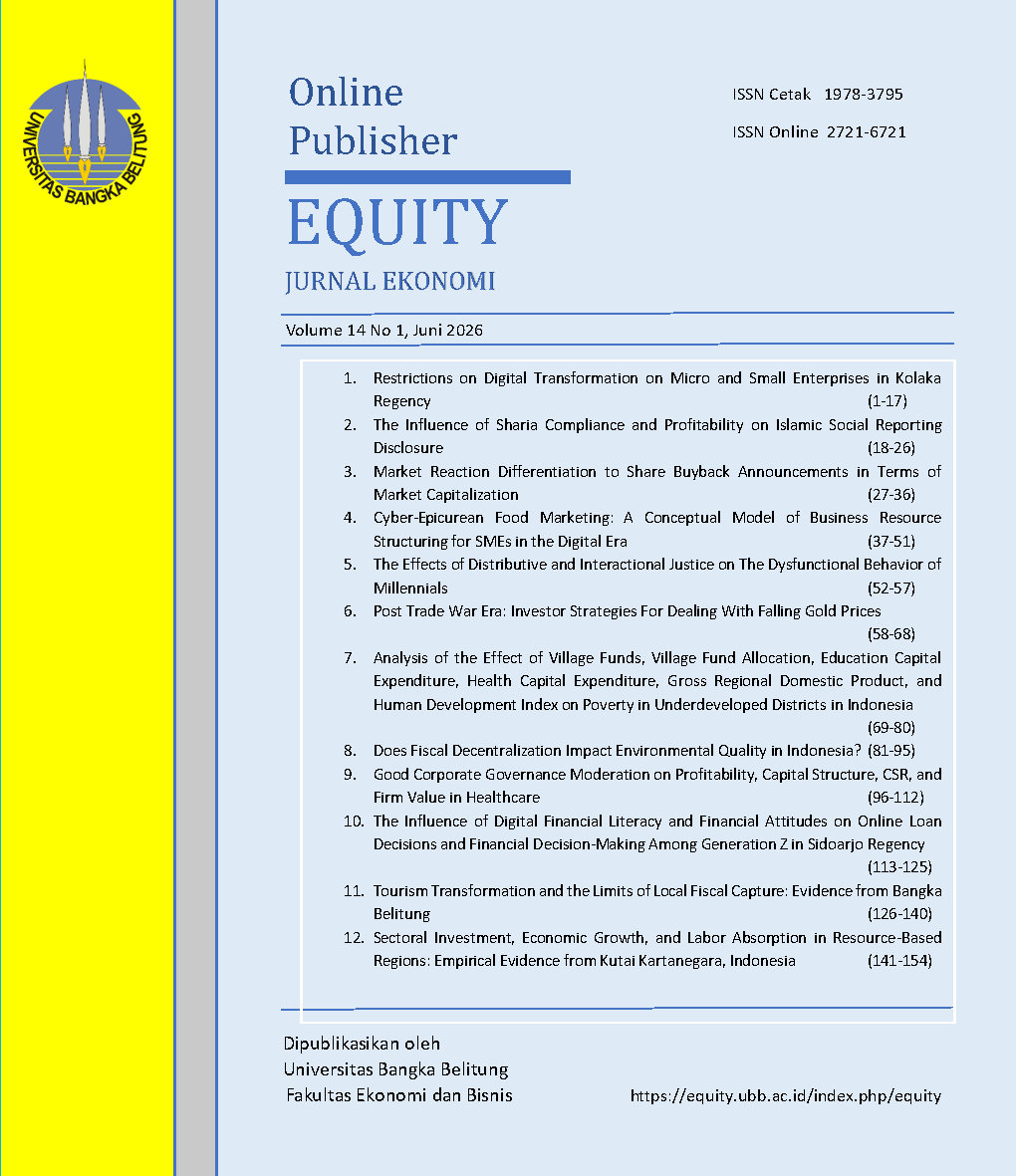
Post Trade War Era: Investor Strategies For Dealing With Falling Gold Prices
DOI:
https://doi.org/10.33019/equity.v14i1.590Keywords:
US–China trade war, global gold price, retail investors, investment strategiesAbstract
This study analyzes the impact of the U.S.–China trade war de-escalation on global gold prices and investor strategies. During 2020–2025, trade tensions drove gold prices upward as a safe-haven asset, yet after the trade agreement in April–May 2025, gold prices declined as market confidence improved and investors shifted to riskier instruments such as stocks and bonds. The research employed a quantitative-descriptive approach using linear regression, event study, and portfolio strategy evaluation based on modern portfolio theory. Data were collected from global gold prices (XAU/USD), volatility indices, the U.S. dollar index, and questionnaires completed by 43 retail investors in Indonesia. The findings show that trade war de-escalation significantly affects gold prices (34.3%) and investor strategies (27.2%). These results highlight the crucial role of geopolitical stability, while other factors such as inflation, monetary policy, and exchange rates also play significant roles. The study recommends portfolio diversification, the application of Dollar-Cost Averaging (DCA), and improved financial literacy to help retail investors adapt to post-trade war market fluctuations.
Downloads
References
Ang, A., & Bekaert, G. (2002). International Asset Allocation With Regime Shifts. The Review of Financial Studies, 15(4), 1137–1187.
Baker, M., & Wurgler, J. (2006). Investor Sentiment and the Cross-Section of Stock Returns. The Journal of Finance, LXI(4), 1645–1680.
Baur, D. G., & McDermott, T. K. (2010). Is gold a safe haven? International evidence. Journal of Banking & Finance, 34(8), 1886–1898.
Bodie, Z., Kane, A., & Marcus, A. J. (2014). Investments (10TH ed.). McGraw Hill Higher Education.
Conlon, T., & McGee, R. (2021). Safe haven or risky hazard? Bitcoin during the Covid-19 bear market. European Journal of Finance, 27(10), 946–966.
Elton, E. J., & Gruber, M. J. (1997). Modern portfolio theory, 1950 to date. Journal of Banking and Finance, 21(11–12), 1743–1759.
Erb, C. B., & Harvey, C. R. (2013). The Golden Dilemma. Financial Analysts Journal, 69(4), 10–42.
Fathimiyah, D. A., & Fianto, B. A. (2020). Pengaruh Variabel Makro Ekonomi Dan Dow Jones Islamic Market Index Terhadap Harga Saham Pada Indeks Saham Syariah Indonesia (Issi) Tahun 2012-2019. Jurnal Ekonomi Syariah Teori Dan Terapan, 7(11), 2183.
Gunadi, P. C., & Robiyanto, R. (2024). Pengaruh Kurs Valuta Asing dan Harga Emas terhadap Indeks Komposit Jakarta selama Perang Ukraina-Rusia. Atma Jaya Accounting Research (AJAR), 7(1), 38–50.
Li, S., & Lucey, B. M. (2022). Reassessing the Role of Gold in Times of Geopolitical and Trade Tensions. Resources Policy, 67.
Markowitz, H. (1952). Portfolio Selection. Journal of Finance, 7(1).
Next Indonesia Center. (2023). Investment Behavior in Indonesia: Gold and Other Safe Haven Assets. Economic and Social Research Report, 45–60.
Sugiyono. (2019). Metode Penelitian Kuantitatif, Kualitatif, dan R&D. Alfabeta.
Walden, P. (2024). Market Reactions to Gold Price Volatility: Opportunities and Risks.
World Global Council (2023). Gold as a Strategic Asset: Portfolio Diversification and Risk Management.
Zhang, H., & Wang, Y. (2024). Trade wars and financial markets: The impact on commodity prices. Journal of International Money and Finance, 128, 102689.
Downloads
Published
Issue
Section
License
Copyright (c) 2026 Selviani, Sintya Gracella, Siti Aisya, Wenni Anggita

This work is licensed under a Creative Commons Attribution 4.0 International License.
Authors who publish journals in Equity: Jurnal Ekonomi agrees with the following conditions:
1. Authors retain copyright and grant the journal right of first publication with the work simultaneously licensed under a Creative Commons Attribution 4.0 International License.
2. Authors are able to enter into separate, additional contractual arrangements for the non-exclusive distribution of the journal's published version of the work (e.g., post it to an institutional repository or publish it in a book), with an acknowledgement of its initial publication in this journal.
3. Every publication (printed/electronic) are open access for educational purposes, research, and library. Other than the aims mentioned above, the editorial board is not responsible for copyright violation.
How to Cite