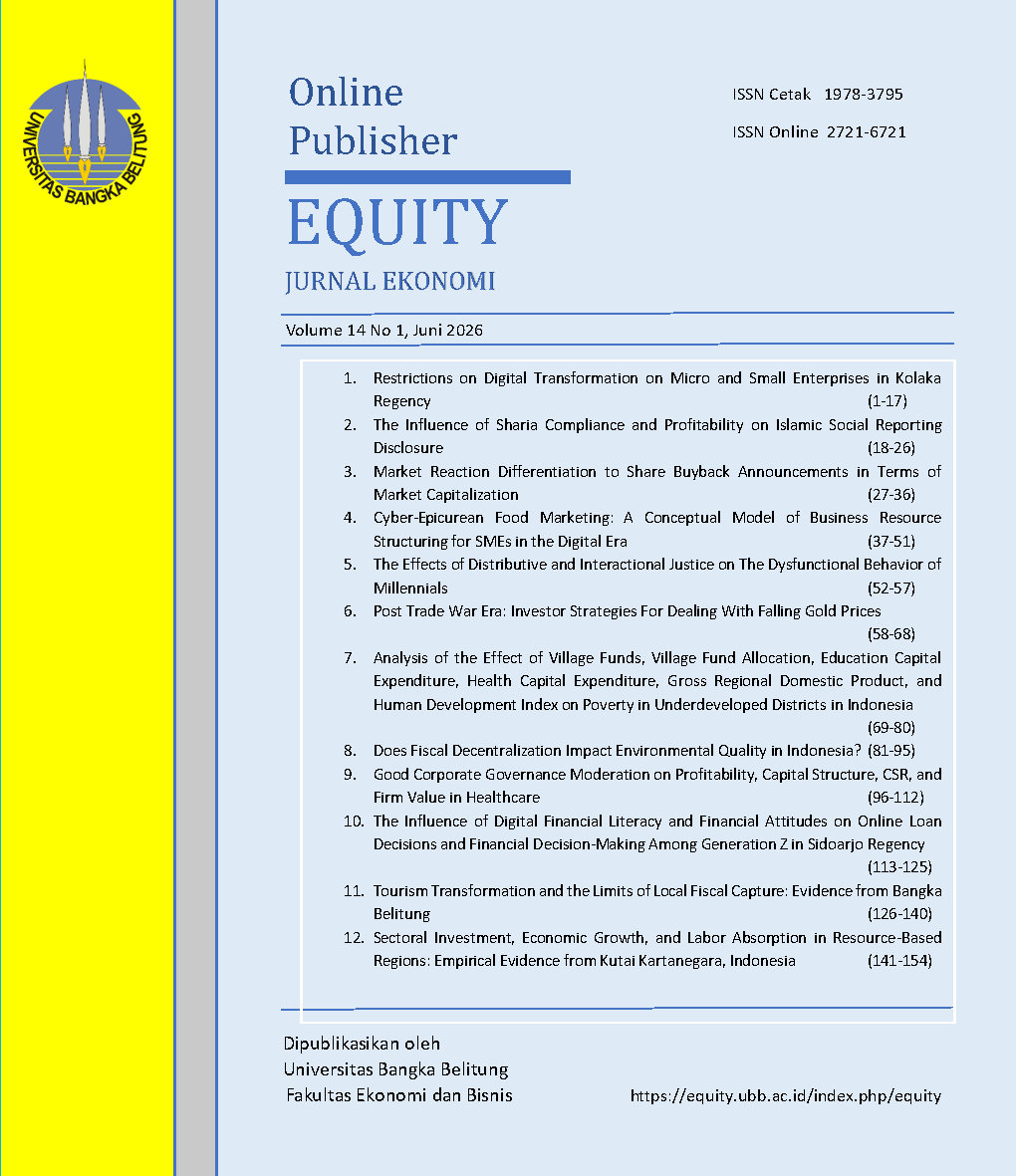
Cyber-Epicurean Food Marketing: A Conceptual Model of Business Resource Structuring for SMEs in the Digital Era
DOI:
https://doi.org/10.33019/equity.v14i1.572Keywords:
Customer Satisfaction, Customer Loyalty, Menu Selection, Hygiene, Cyber MarketingAbstract
This study investigates the influence of sensory experience (SE), satiety value (SV), menu selection (MS), hygiene (HYG), and price (PRC) on customer satisfaction (CS) and customer loyalty (CL) within the context of small and medium-sized culinary enterprises. Using regression analysis, the findings reveal that MS and HYG are the dominant predictors of CS, while SE, SV, and PRC also contribute positively, though to a lesser extent. CS is confirmed as a strong predictor of CL, highlighting that higher satisfaction directly fosters repeat patronage and positive word-of-mouth. However, the introduction of cyber marketing (CM) shows a negative direct effect on CL and no moderating influence on the CS–CL relationship, indicating that current digital marketing strategies remain insufficient in strengthening loyalty. These results emphasize the importance of enhancing core service quality dimensions, particularly menu variety and hygiene, while redesigning digital marketing initiatives to complement customer experiences and build sustainable loyalty.
Downloads
References
Ahmed, S., Mohiuddin, M., Rahman, M., Tarique, K. M., & Azim, M. (2022). The impact of Islamic Shariah compliance on customer satisfaction in Islamic banking services: mediating role of service quality. Journal of Islamic Marketing, 13(9), 1829–1842. https://doi.org/10.1108/JIMA-11-2020-0346
Ali Larik, K., & Karim Lashari, A. (2022). Effect Of Leadership Style On Employee Performance. Neutron, 21(2). https://doi.org/10.29138/neutron.v21i02.143
Anderson, J. C., Kumar, N., & Narus, J. A. (2022). Customer satisfaction and loyalty in foodservice: A cross-national perspective. Journal of Foodservice Business Research, 25(3), 211–229. https://doi.org/https://doi.org/10.1080/15378020.2022.1234567
Astarina, I., Fikri, K., Loka, S. F., & Fadilah, M. R. (2019). Pengaruh Kompensasi Terhadap Kinerja Perangkat Desa Se- Kecamatan Rengat Yang Dimediasi Oleh Motivasi Kerja. Jurnal Ilmiah Mahasiswa Manajemen Dan Bisnis, 2(1).
B2042171011, H. N. (2019). KOMPETENSI DAN KEPEMIMPINAN, DAMPAKNYA TERHADAP KEDISIPLINAN DAN KINERJA PEGAWAI KANTOR DINAS KESEHATAN, PENGENDALIAN PENDUDUK DAN KELUARGA BERENCANA KABUPATEN SEKADAU. Equator Journal of Management and Entrepreneurship (EJME), 7(4). https://doi.org/10.26418/ejme.v7i4.34534
Barney, J. B. (1997). Gaining and sustaining competitive advantages. Addison-Wesley Pub. Co.
Beer, M., Boselie, P., & Brewster, C. (2015). Back to the future: Implications for the field of HRM of the multistakeholder perspective proposed 30 years ago. Human Resource Management, 54(3), 427–438.
Chan, K., & Wong, T. (2023). Menu variety, customization, and customer satisfaction in foodservice. International Journal of Contemporary Hospitality Management, 35(4), 1221–1238.
Chen, Y., Li, X., & Park, J. (2023). Cyber marketing and customer loyalty in SMEs: The role of digital engagement. Journal of Business Research, 156, 113456. https://doi.org/https://doi.org/10.1016/j.jbusres.2023.113456
Febrian, W. D., Lesmini, L., Indriyati, I., Perwitasari, E. P., Marlita, D., Hernawan, M. A., Lindawati, L., Sarinastiti, N., Ricardianto, P., Tahir, A. M. S., Rinaldy, F. F., Jumawan, J., Widyastuti, T., Soehaditama, J. P., Susanto, P. C., Sawitri, N. N., Supardi, S., Nuraeni, N., Handayani, S., … Armelia, A. K. (2023). Dasar-Dasar Manajemen Sumberdaya Manusia. In Eureka Media Aksara.
Hanaysha, J. (2016). Measuring customer satisfaction: The impact of price, food quality, and service quality in the culinary industry. Asian Journal of Business Research, 6(2), 14–28.
Haryanto, R. (2021). Manajemen Sumber Daya Insani Dalam Membentuk Budaya Kerja Islami. Pendidikan Multikultural.
Hendrawan, A., & Utami, N. (2022). Cyber marketing adoption and loyalty among Indonesian SMEs. Journal of Small Business and Enterprise Development, 29(5), 765–783.
Kelvia, T., Amelia, R., & Ronald, P. (2023). Analysis of sensory experience, menu selection, and hygiene on satisfaction and loyalty in fine dining customers. Journal of Culinary and Hospitality Studies, 11(1), 33–47.
Kim, H., & Lee, S. (2021). Hygiene practices and customer satisfaction in institutional foodservice during the COVID-19 pandemic. International Journal of Hospitality Management, 95, 102925. https://doi.org/https://doi.org/10.1016/j.ijhm.2021.102925
Kim, J., Park, S., & Lee, H. (2022). The role of price fairness in shaping customer satisfaction in emerging markets. Asia Pacific Journal of Marketing and Logistics, 34(7), 1458–1475.
Kurniawan, A., & Prasetyo, D. (2022). Sensory experience and revisit intention in Indonesian culinary SMEs. Journal of Consumer Sciences, 7(2), 112–124.
Lee, Y., Zhang, L., & Cho, M. (2023). Sensory experience and customer loyalty in restaurants: Evidence from East Asia. Service Business, 17(3), 455–473.
Nguyen, T., Le, P., & Tran, H. (2022). Satiety value and consumer trust in urban dining. Journal of Retailing and Consumer Services, 68, 103031.
Oliver, R. L. (2015). Satisfaction: A behavioral perspective on the consumer (2nd ed.). Routledge.
Putri, M., Santoso, H., & Lestari, V. (2022). Hygiene and customer perception in food and beverage SMEs post-pandemic. Indonesian Journal of Business and Entrepreneurship, 8(1), 45–58.
Rachmawati, N., & Sukmawati, S. (2025). Pengembangan Usaha Mikro Kecil Menengah (Umkm) Menjadi Perusahaan Go Public. JURNAL EKONOMI, KEUANGAN, PERBANKAN, KEWIRAUSAHAAN DAN KOPERASI, 6(1), 21–27.
Rahardjo, F., & Setiadi, Y. (2021). Satiety value and satisfaction in Indonesian casual dining. Gadjah Mada International Journal of Business, 23(2), 178–193.
Rahmawati, N., & Susanto, R. (2020). Cyber-epicurean marketing in SMEs: Integrating digitalization and customer satisfaction. Journal of Indonesian Business and Entrepreneurship, 6(3), 201–214.
S. R. Yeomans. (2021). Galvanized Steel in Concrete: An Overview,. 1–30. https://doi.org/10.1016/B978-008044511- 3/50016-5
S. Yadav, P. Mehta, A. Singh, and S. Y. (2024). Advancements in Fish Harvesting. Technology: Toward Sustainable Fisheries Management 20 (p. 298). Indian Pub.
Sari, D., & Handayani, F. (2021). Price fairness and satisfaction in Indonesian SMEs. International Journal of Economics and Business Administration, 9(4), 89–103.
Spence, M. (1973). Job Market Signaling. The Quarterly Journal of Economics (pp. 355–374). Newy York Inc.
Susanto, R., & Hidayat, A. (2020). Menu selection and satisfaction in Indonesian culinary SMEs. Journal of Culinary Research, 4(2), 87–96.
Turan, H. Y., & Cinnioğlu, H. (2022). Agile leadership and employee performance in VUCA world. In Agile Management and VUCA-RR: Opportunities and Threats in Industry 4.0 towards Society 5.0. https://doi.org/10.1108/978-1-80262-325-320220003
Widodo, Z. D., Purwaningrum, J. P., Purbasari, I., Rini, G. P., Putra, A. R., Uran, B. E. K. R., Mulyani, M., Soegoto, A. S., Nugroho, L., Nurzianti, R., Nugroho, H., Sudirman, A., Santosa, S., Novianti, R., Pattiapon, M. L., Pinem, D., & Ridwan, N. H. (2022). Manajemen Koperasi dan UMKM. In Widina Bhakti Persada.
Wijaya, T., & Santoso, B. (2020). Customer satisfaction and loyalty in the Indonesian foodservice industry. Journal of Asian Business Strategy, 10(1), 45–55.
Zhang, W., Chen, X., & Li, M. (2023). Hygiene and satisfaction in the post-COVID restaurant industry. Tourism Management. Tourism Management Journal, 92, 104575.
Zhao, Y., Wang, L., & Xu, J. (2023). Digital transformation and customer loyalty in the foodservice industry. International Journal of Hospitality Management, 102, 103201.
Downloads
Published
Issue
Section
License
Copyright (c) 2026 Chavid Moyo Jaladri, Agus Wisatono

This work is licensed under a Creative Commons Attribution 4.0 International License.
Authors who publish journals in Equity: Jurnal Ekonomi agrees with the following conditions:
1. Authors retain copyright and grant the journal right of first publication with the work simultaneously licensed under a Creative Commons Attribution 4.0 International License.
2. Authors are able to enter into separate, additional contractual arrangements for the non-exclusive distribution of the journal's published version of the work (e.g., post it to an institutional repository or publish it in a book), with an acknowledgement of its initial publication in this journal.
3. Every publication (printed/electronic) are open access for educational purposes, research, and library. Other than the aims mentioned above, the editorial board is not responsible for copyright violation.
How to Cite